Kamis, 28 Juli 2011

EVENTS - AUGUST 2011

AUGUST 

PEKAN RAYA SINTANG - SINTANG CITY
In Sintang Regency, a longer festival to celebrate the 64th Independence Day of the republic Indonesia promotes it's local cultures. This is an ideal spot to see traditional dance, sports, exhibits, and games.

FESTIVAL BUMI SENENTANG - SINTANG CITY
The Bumi Senentang Festival is part of the Proclamation Day festivities in West Kalimantan. The Dayak and Malay cultures heritage is displayed throughout Sintang.

TOURIST INFORMATION
TELP. 62-565-21204 / 62-561-742838
FAX. 62-565-21204-21003 / 62-561-739644

 PAGELARAN SENI BUDAYA MELAWI
 [MELAWI CULTURAL DISPLAYS] - MELAWI REGENCY, NANGA PINOH
Melawi Cultural Displays commemorate the 66 Independence day in the Melawi Regency. Cultural shows and traditional games are performed for locals and visitors.

TOURIST INFORMATION
TELP. 62-568-22521 / 62-561-742383
FAX. 62-568-22221 / 62-561-739644

Posted By : Rachmahditha Mega N.
Source : Event Calendar 2011

Selasa, 05 Juli 2011

SUMPIT - DAYAK TRIBES TRADITIONAL WEAPON


The picture above is Modern version of Sumpit - Dayak's traditional weapon. It made from light wood with a minimum length 1,50 meters and the longest 2,25 meters. For dayak tribe, it usually used as weapon to hunt the animal in the forest. If the dayak tribe in danger it usually used as weapon to attack enemy with bullet made by wood and needle that has poison on it. There's different used and length for man and women use. Man usually use the longer one than the women use. If the adult man use 2,25 meters in length, the woman will use 1,70-1,75 meters in length. If the user is Boy they will use 1,85-1,90 meters in length and girls will use 1,50-1,65 meters in length. This Weapon has special treatment, we can't put in on the floor or step on it (melangkahi) it will make the Sumpit can't work normally because it kept by angel. 

The original Sumpit will not use wooden knife on the end, but use metal knife that can hurt and stab the enemy. The way to hold Sumpit is not like you use gun you need to hold the part below with both hand.

 The part you will hold with both hands.

The hole on the picture above is to blow the air to push the bullet. You don't do the breath with your nose but deep lung. You need to hold it about 5 seconds then release it.

Source        : Rachmahditha Privat photo and experience
Properties  : Rachmahditha's own Sumpit
Posted by   : Rachmahditha M.N.
Thanks To : Stephanus Paiman OFM CAP, Christianus Samanyuk, Stephanus Josua Kayo, Christhophorus Fernando Pangaraga and FRKP.


Minggu, 03 Juli 2011

The Legend of the Name of Pontianak

         Do you believe that the name of Pontianak came from one of the ghost? Well, almost all of the citizens in Pontianak believe that the name of Pontianak means kuntilanak or female ghost. People said that when Sharif Abdurrahman Alkadrie, the eldest son of Al Habib Husin, arrived in the mainland of Pontianak, he met the kuntilanak and defeated         it.


Sultan Abdurrahman Sharif Alkadrie is was the Founder and the first Sultan of the Kingdom of Pontianak. He was born in 1142 AH / 1729 / 1730 AD. He is son the son of Al HabibHusin, a disseminator of Islam Arab origin. Three months after his father passed away in the kingdom of Mempawah, Abdurrahman Sharif Alkadrie and his brother tried to find a new place for living. They crossed the Peniti River along Kapuas River by fourteen boats till they arrived at KelapaTinggi
,
Segedong. Sharif Abdurrahman Alkadrie felt that the place was not a good one for living so they continued their journey. Then they arrived at an island, and they named it Batu Layang. 

In this island they were disturbed by a female ghost called Kuntilanak and Sultan asked his soldiers to defeat it by shot it by a cannon. Before he shot it
,
he promised himself, “I will build a new kingdom wherever the cannon ball fall down!” They succeeded to defeat the Kuntilanak and they found that the cannon ball fell down in a place where they built a new kingdom.


            They decided to name the new place as Pontianak. The name of Pontianak was taken from Kuntilanak. People in Pontianak still shoot the cannon without the ball as their tradition to remember the story. This tradition usually held on the ceremonial days such as Ramadhan, Eid, and New Year.
by: Friscka br Manurung
source: Marshauli Kristiari Sitindaon

How to Make Pasung Cake

       Have you ever eaten pasung ?  It’s a very  delicious food  from West Kalimantan. not only the taste is good, but it is also not easy to rotten. You can  find it in Ramadhan month.  Every Ramadhan, almost all of malayan in Sambas  make pasung as their tradition. According to them, pasung is made to open  the chain that bundled the spirit. Pasung is almost similar with nagasari, but it has  no banana slice. For you that want to make it by  yourself, you can follow  a two-main step procedure  : preparing the ingredients and  making the Pasung cake.


First, preparing the ingredients can be devided into two steps,  they  are  two kind of dough that should be made. For the first dough, the  ingredients that you should prepare are 150  gram of rice  flour, 300 gram of   java sugar (boil with 150 cc of water, and filter it), 500 cc of coconut milk, and 50  gram of sago  flour.  for the second dough, the ingredients are 1000 cc of thick coconut milk, 75 gram of java sugar, salt, 50 gram of rice flour, 30 gram of sago flour, 125 cc of water, and the last one is banana’s leafs as the cone.
 
Next, we come to the process to make pasung. It is also divided into three steps. The first step is mixing the rice flour and java sugar  for ten minutes. We do the same thing to the coconut milk and sago powder. Then, mix the whole dough into one dough called .  Stir it for a while by wooden spoon. We call it the first dough. The second step is to make the second dough by cook the coconut milk   until it oily. We  also cook Java sugar, salt, and 75 cc of water till boiled, and then filter it. We put it into basin and do not forget to mix it with rice  flour. The mixture of sago powder and water is mixed into the dough of rice powder and coconut milk. The last step is  putting in the first dough into the cone of banana’s leaf about ¾ of it, then steam it. If the texture looks little bit harder, we continue to put in the second dough on it. Then, we steam it again until it really done.


It is not really hard to make pasung. You do not need wait until Ramadhan  comes, if you want to eat it. You can make it by  yourself at your home, because the process is easy to do. Besides that, you can also try to sell it as your family’s income. Just try it, it works.


by: Friscka br Manurung
source: Niah Sugiarti

Sabtu, 02 Juli 2011

The Funeral Ceremony of Chinese Tradition in Ketapang West Borneo


This is a funeral ceremony of Chinese tradition in Ketapang West Borneo when my friend’s dad Tuti died. The picture in the left is her father was in the coffin. If in common people used a shroud, Buddhist wears clothes such as shirt, trouser or dress according the family then covered by red slip cover and the “money” for people who died (the brown paper as the man hold on at the picture) on the face. In the coffin there is money, tea leaves (to keep the smell of the corpse).


People at the picture are the family of the corpse and they are holding the incenses to pray in front of the coffin. On the table there are photo, two candles in the left and the right side, fruits, pork, chicken.


The children of the corpse are in front of line that wears white clothes, white headband, and white ‘bracelet’. The other person who wears blue headband is the family of the corpse.


The picture above was the burial process in the hill. There are so many people from family or neighbor came to see the burial. The location of the burial is basically to the clan. Each clan was has a criterion by virtue of the foundation where they were. The corpse is from Lay clan so, he was buried among other graves that with Lay clan.


This is the process to put the coffin into the grave. At the picture there is a man who holds the bamboo. The person who can hold this bamboo is the son-in-law of the corpse.


After the burial process was finished, the tradition is to get small change or green peal and rice. The meaning of this tradition is that symbolize wealth and prosperity for anyone who get that things. More and more people get that things, the belief are they will get fortune and blessing for everything 
by: friscka br manurung
source : Tuti Marinus Laylani

Selasa, 14 Juni 2011

The History Of Kelam Hill In Sintang, West Borneo

Have you ever heard about Kelam hill in Sintang, West Borneo?
It is beautiful and exotic place in Sintang City.
Kelam hill also have story that popular in Sintang society.


       Once upon a time in Sintang, we need we had two leaders who were descendants of the Gods. they had supernatural powers, but had different nature, the first named Bujang Beji, a leader which has the natural evil, destroyer, spiteful, and greedy, that is why many people hate him.while the leaders of the two named Tumenggung Marubai. He has a nature nature which is contrary to the Bujang Beji, Tumenggung Marubai was helpful, good-hearted, and humble. 

         Both of them worked as fisherman, and farmer. Bujang Beji commanded on the branch of Kapuas River and Temanggung Marubai commanded on the branch of Melawi River. The problems started when the river which was commanded by Temanggung Marubai had more fish than the river where Bujang Beji was fishing. It made Bujang Beji was jealous because the fish that he caught was not as many as Tumenggung Marubai.

           Then Bujang Beji devised evil intentions to drain out the fish in the river where Temanggung Marubai fishing. He lifted the top of Nanga Silat hill to steam the river where Temanggung Marubai fishing, in the journey between Nanga Silat and Melawi River the goddesses anoyed him, so he failed to steam the river.

           He was angry to the goddesses and planned to kill them. Bujang Beji tried to plant trees that would be used as a way to reach heaven and kill the goddesses who had laughed at him.He was angry to the goddesses and planned to kill them. In recent days, tall trees had grown until reach the sky. The top of tree could not see from earth.

          Before climbed the tree, Bujang Beji held traditional ceremony which was helped by all animals and evil spirits, but there were missing animal such as ie, termites swarm and bears. They were very angry, so they tried to uproot the tree with tree roots undermining for brittle. When Bujang Beji would climb the tree, the tree was cracked and Bujang Beji was crashing. Bujang Beji died and his body was taken by people to be made as a talisman.  The top of Nanga Silat hill which tried to borne by Bujang Beji, eventually became a hill that is known as Kelam hill.
These are the view of Kelam Hill now 


By: Friscka Br Manurung
Source: Septi setiany , Alex Fleming ( facebook )


The Ritual Of Robo - Robo In Mempawah, West Borneo

            
         Robo-robo is a traditional ceremony from Mempawah, West Borneo. The word Robo-Robo itself means Wednesday, which means that Robo-Robo is held on the last week of Syafar, the Islamic month. Robo-Robo is held by Mempawah society as a memorial service for the journey of Opu Daeng Manambon, also known as Pangeran Mas Surya Negara from Matan Kingdom to Mempawah Kingdom on Syafar. Some people in Indonesia, especially in West Borneo, believe that Syafar is a disaster month. Therefore, besides held as a memorial service to Opu Daeng Manambon, Robo-Robo is also held to avoid the disasters which may come in Syafar. Robo-Robo has become annual ceremony or event that has its own history for Mempawah society.


The beginning of this story was when Opu Daeng Manambon and her wife Putri Kesumba came to Mempawah kingdom from Matan kingdom, Ketapang in 1148 `Hijriah or 1737 to receive the authority from Panembahan Putri Cermin to Putri Kesumba. So, Putri Kesumba was known as Ratu Agung Sinuhun, and her husband, Opu Daeng Manambon was known as Pangeran Mas Surya Negara. Opu Daeng Manambon and his wife sailed along with forty boats of their watchmen. When they arrived in Mempawah, they were welcomed by Mempawah society gladly and nicely who have waited at the bank of the river. There were so many colorful paper and clothes at the people’s houses around the river.

Opu Daeng Manambon and his wife, Putri Kesumba felt happy and honored for the welcoming. To say his grateful to the people, Opu Daeng Manambon asked his watchmen to take their food and give it to the society in order to be eaten with Mempawah society. The coming of Opu Daeng Manambon and his wife coincided on the last week of Syafar. So, besides welcomed Opu Daeng Manambon and his wife, according to the belief that Syafar was the month of disasters, the people and Opu Daeng Manambon, as well as his wife prayed together to God to be avoided from the disasters before they ate the food.
The next year, Mempawah society held the same ceremony or they called Robo-Robo on the last week of Syafar on Wednesday, outside of their house with their families. The people started Robo-Robo after they prayed Zuhur. Then, before Robo-Robo was started, the people echoed adzan and prayed to God to be avoided and protected from the disasters. Next, they did the ritual to keep the disasters away by throwing away the offering stuff for the spirits to Mempawah River. Finally, they ate all the food that they had made and served together. 


  Through this ceremony, Mempawah society broke the pillar of differences; religion, social status, and race. Everyone can join in this ceremony.


By : Friscka Br Manurung
Sources : Mega Zulfitriani, Lusken Pradesy Manik, Septy Setiani, and Onten Juliantini

Sabtu, 23 April 2011

The biggest ethnic group in West Kalimantan

( Malayan )
( Dayakness )
                                                                                           ( Chinese )


1.                                                          1. Dayakness

I have friend who a dayakness and her name is Aurelia Ita. She is a Ahe dayakness because dayakness has some kinds such as dayak mualang, dayak iban, dayak kanayatn, dayakma’ayan, dayak sawe, Dayak ketungausasai, dayak are’, dayak bidoih, dayak kenyah, dayak pompakng, dayak benyadu, dayak sungkukng and etc.  she is a catholic and mainly even almost dayakness people are catholic.


This picture above is aurel’s photo when she joined an event when we were in senior high school. She is wearing dayakness traditional clothes.


This picture above is a  photo of our friend's wedding party  with dayakness traditional clothes and culture.


2.       Chinese 
I have friend who a Chinese and her name is Tuty Marinus Lailani. She is a Tio Chu Chinese. because of the same with dayakness, Chinese has some kinds too such as Hok Lo / Tio Chu Chinese, Ke' Chinese, Hokien Chinese, Mandarin Chinese and etc according to what language their use.
Tuti is a Buddhist and student of medicine faculty in University of Tanjungpura. 


                 3. Malay ( Malayan )

The last ethnic group is Malay, and to explain about it I will give a figure. The figure is also my friend and her name is Oktavianty. She is a student of economy faculty in University of Tanjungpura. She is a Muslim and friendly. Me, Aurel, Tuti and also Okta came from different background and culture but we live in West Kalimantan. Accidental we live in the same house with harmonious.


posted by Friscka Br Manurung
source by Tuti Marinus Lailani, Aurelia Ita, and Octavianty


Rabu, 20 April 2011


Tattoo is one of dayak tribe's culture. For boy that growing up to adult it's a sign that they already grew from a boy to a man that have wise and brave soul. the traditional clothes that wore around the neck is made by bears leather. From the picture above, the man on the left is the leader or we can said that he is a captain [Panglima] the bird he wore in the head is a symbol of in what level he is. The man in the right is the assistant or we can said the level is lower than the captain.

Posted by : Rachmahditha M.N
Source      : Ditha's privat photo Gawai Dayak 2007
Thanks to : Christianus Samanyuk and Alexander Batutebo

DAYAK FESTIVAL SONGS

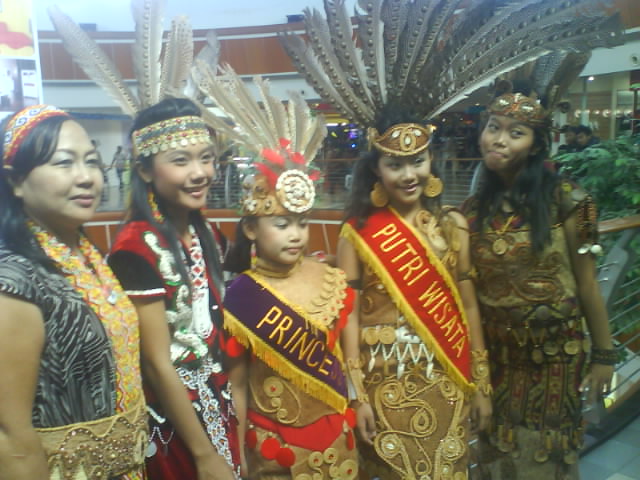
This picture was taken at the time song festival Dayak provincial level. They use the traditional clothes Dayak. The winners take one woman and man. This event was held at the longhouse in Pontianak. This picture was taken after acceptance of gifts.

Posted by : Irine Adistya


FUNDRAISING

The picture was taken during event held at the mega mall Pontianak. They display many indigenous Dayak such as traditional dances, traditional songs as well as clothing and traditional musical instrument.many tourists who are interested so that they donate a lot of money for this event. Finished the event brand and collect all the money donated to victims of the eruption of Mount Merapi in Java.

Posted by : Irine Adistya

Minggu, 10 April 2011

Maitreya Statue ( Buddhist Symbol )


This statue name is MAITREYA the symbolize of BUDDHA. And behind this statue is the place for Buddhists prayer.  In West Kalimantan, population of Buddhist are rash part enough. The Buddhist came from the Chinese People in West Kalimantan.  The biggest center of Buddhist In West Kalimantan placed in Singkawang city, but now in Pontianak there is a big Vihara named Vihara Maitreya.


This photo was taken when Waisak celebration in Vihara Maitreya. We can see that the Maitreya statue and the Vihara decorated with colors fickering lights. In Waisak celebration more Buddhist come to this Vihara to
pray.


The picture above is place for Buddhists to pray . There is the altar and Buddhists praying  with take a bow facing to the Maitreya statue.


The picture above is a photo of KBMB ( Keluarga Besar Mahasiswa Buddhis ). This community is a community where the Buddhist college students from all faculties In University of Tanjungpura Pontianak come together in a place to interact each other.


posted by Friscka Br Manurung
source by Tuty  Marinus Laylani


Sabtu, 09 April 2011

Typical stuff Dayak tribe


The picture above is traditional goods of Dayak tribes. This is made from manik-manik that have various things such as : handbags, clothes, wallets, necklaces and many others.

Posted by : Irine Adistya


The picture above is traditional costums of Dayak tribe. These costums made from kapuak (bark of wood) and on the head there is Enggang Gading feather.
posted by : Irine Adistya

Sabtu, 26 Maret 2011

Introduction and Culture


This video made by Fritaren for viewer to understand about culture in West Borneo / Kalimantan.
Introduction per culture by Fritaren [Friscka, Irine, Rachmahditha]. In this Video you can see Traditional Dayak, Chinese, and Malayan culture. Traditional houses and Temple is the one we can find in Pontianak.
For Dayak and Malayan houses we search for the real house that is still used by people. The temple we used that has a Kwan Im statue and full place for praying in A.YANI 2. For the dayak house we used in Sutoyo st. Malayan house we need to go to more than 6 Km inside Sui. Itik and the house already used since the anchestor of the owner of the house live.

Cameramen : Supriyanto, Rachmahditha, n Friscka.
Script by     : Irine n Friscka.
Edited by     : Rachmahditha
Posted by    : Rachmahditha Mega n.

Kamis, 24 Maret 2011

KWAN IM STATUE

The picture above is the Statue of KWAN IM Goddes. Kwan Im Goddess has three birthday in a year. It is on February 19, June 19 and September19. This picture is the symbolize of Khonghuchu people. 

Posted by : Irine Adistya

Selasa, 22 Maret 2011

GALAHERANG

WEST KALIMANTAN / BORNEO traditional song.
FN 2010 


        This song tell us about how a General fill his promise. Using traditional boat called 'sampan'. The traditional boat known as GALAHERANG. The General going anywhere using Galaherang. He going to fill his promise using Galaherang. The song said that the River and the Boat stand as a witness of General's promise. If he fail to fill his promise, his life will be the bet.


Thanks To : PUBDEKDOK FN2010
                        - Pramitha Putri
                        - Mega Zulfitirani
                        - Zhevy Zulva Hakim
                        - Winda Hartini
                        - Irine Adistya
                        - Rezza Anugerah (guitar)
                        - Fatimah (camera)
Posted By : Rachmahditha M.N.

Senin, 14 Maret 2011

Gita Permata Nusantara

Spreading West Kalimantan Culture by Showing it to the world that we can and we have culture originally from Indonesia. This Video we get from Irine's experience in "Parade Lagu Daerah Gita Permata nusantara 2010"


Source       : Irine Adistya 
Posted by  : Rachmahditha M.N
Edited by   : Friscka Br. M.
NB : comments are loved

Minggu, 06 Maret 2011

Dayak tribe's traditional house

The picture above is the original one of Dayak's traditional house. Dayak tribe is one of the three tribe in West Kalimantan beside Chinese and Malayan. The Original house like this can't be found in pontianak. You can find it deep inside west kalimantan where the origin of Dayak was the base of it.


Posted By : Rachmahditha M.N